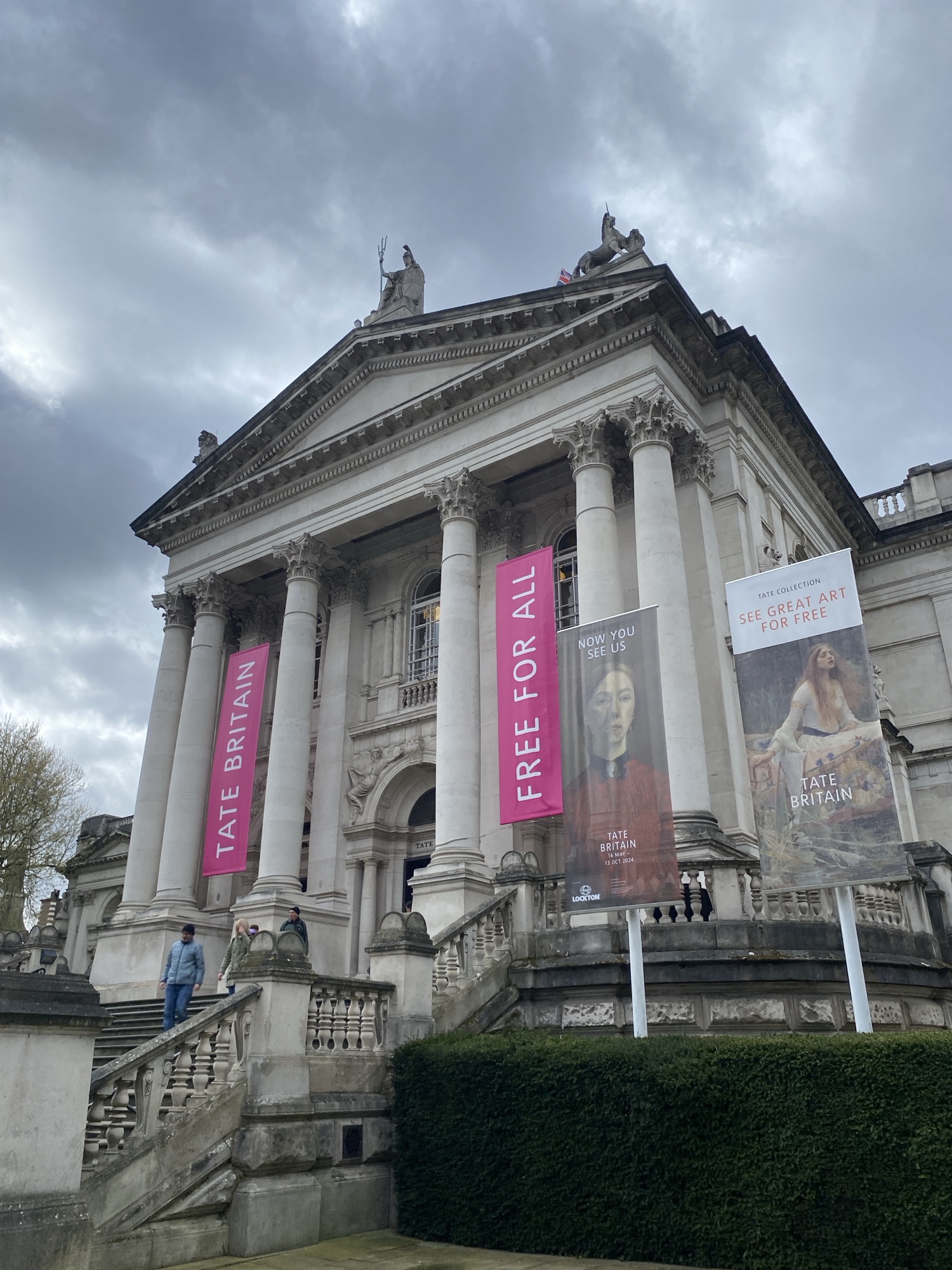
Outside the Tate Britain hang two giant banners. One has the gallery’s name and the other reads, “Free for all.” It is such a beautiful sentiment–and almost true, if you squint with one eye closed.
I love the idea of a public gallery. I love it that, in theory, anyone can walk off the street and look at a work of art that is or has been in a private collection. I have personally benefited from accessing public galleries over my lifetime. There is something so comforting about seeing a painting, for example, over decades. The meaning changes as I age as I read my life experience into the topics, brush strokes, and expressions of the works.
But even as I feel the warm fuzzies about seeing the works, I am also aware of another, uncomfortable reality. While the Tate Britain is a public gallery, and the art within it might be “free for all” there is a lingering question of how it’s “free” and who the “all” refers to.
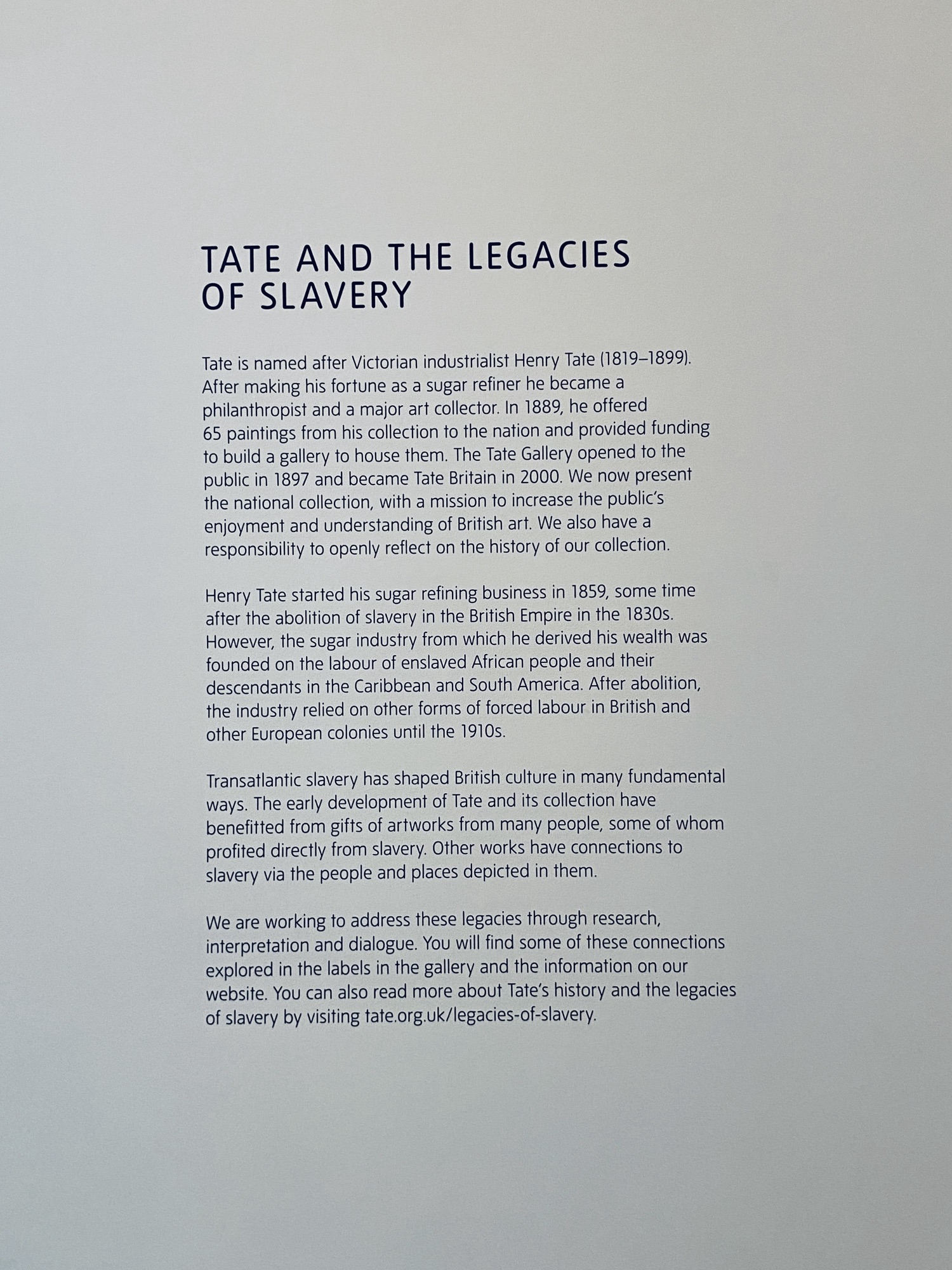
A wall title installed in the foyer just before the galleries acknowledges and makes clear the direct link between the collections and the wealth gained by both direct and indirect enslavement of African people as well as forced labor. This small statement is a good start, but remains only that–a start. The dialogue of colonization is missing entirely, for example. It is a step, a tiny step, towards contending with the harmful histories linked to art and wealth. Along with this statement, the Tate Britain collaborated with The Centre for the Study of the Legacies of British Slavery to craft a fuller acknowledgement on their website.
It can be tempting, as a well intentioned white woman, to let these kinds of statements assuage the feelings of discomfort as I walk through the spoils of structural violence. I can look at my favorite paintings and continue down a path of woke comfort, completed with a ticky box check.
Or…
I can let the uncomfortable settle into my spine a bit more. When I do that I am present to a few more questions I wouldn’t have access to if I move away too quickly from being unpleasant feelings.
If national public galleries are filled with the private collections of the wealth folks who directly or indirectly benefited from enslaving people, what kind of art do they bring in? More importantly, what art is missing from their collections? Who feels comfortable looking at these collections? Who feels uncomfortable, and why?
And then, thinking of the idea of a “free” gallery, what is the cost of this gallery? And who has paid for it? If we honor the contributions of the wealthy who voluntarily give a fraction of their wealth to support a national gallery, how do we contend with the involuntary contributions of enslaved and exploited people and labor that made the donor’s wealth possible?
As I wander though the marble halls of this massive “free” national gallery, I let these questions linger. They are new to me, but they are not new. In other words, I am new to them–a late arrival 20 years into my relationship with the Tate Britain.
 Alexandra Ross Works