
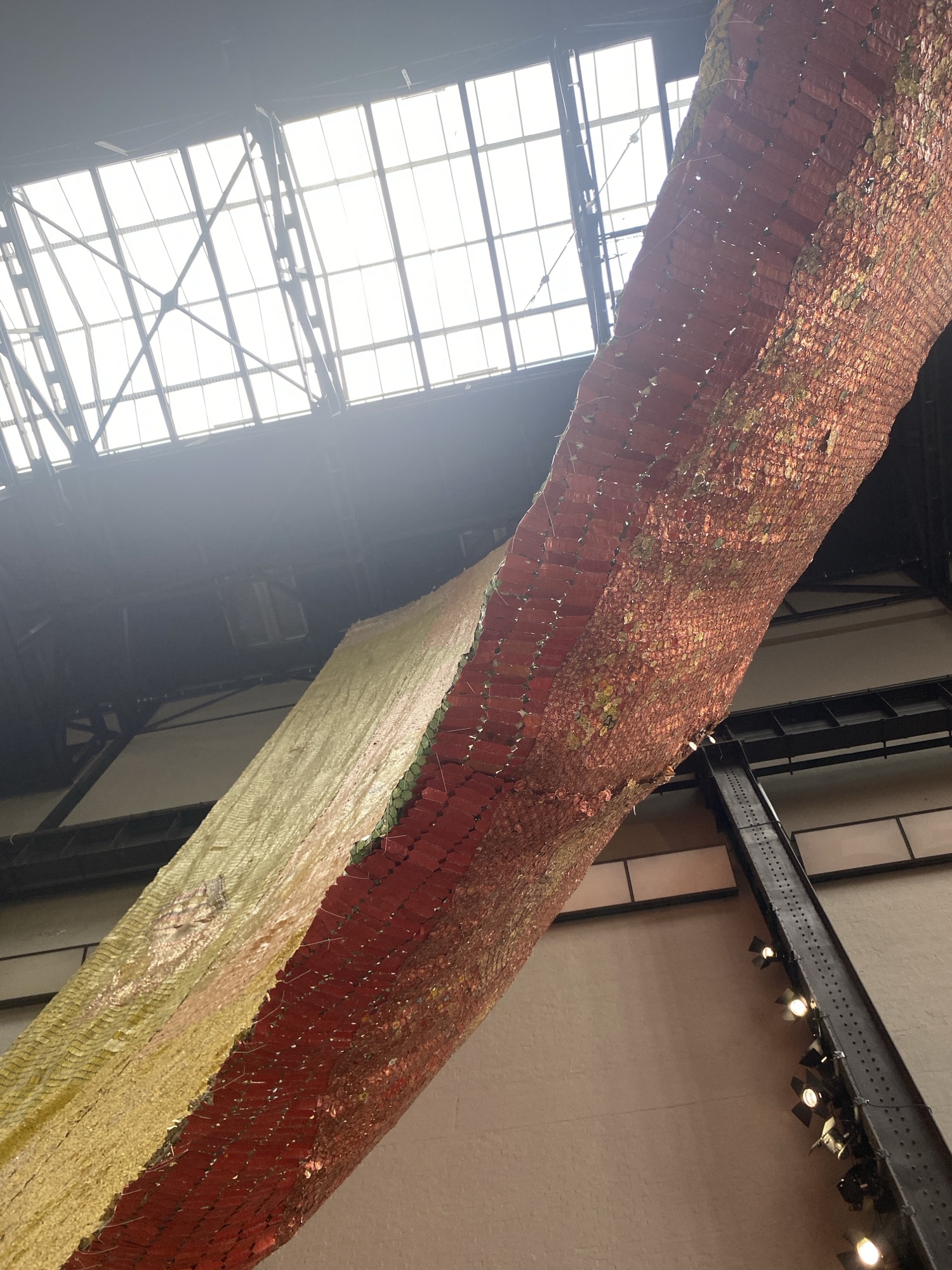
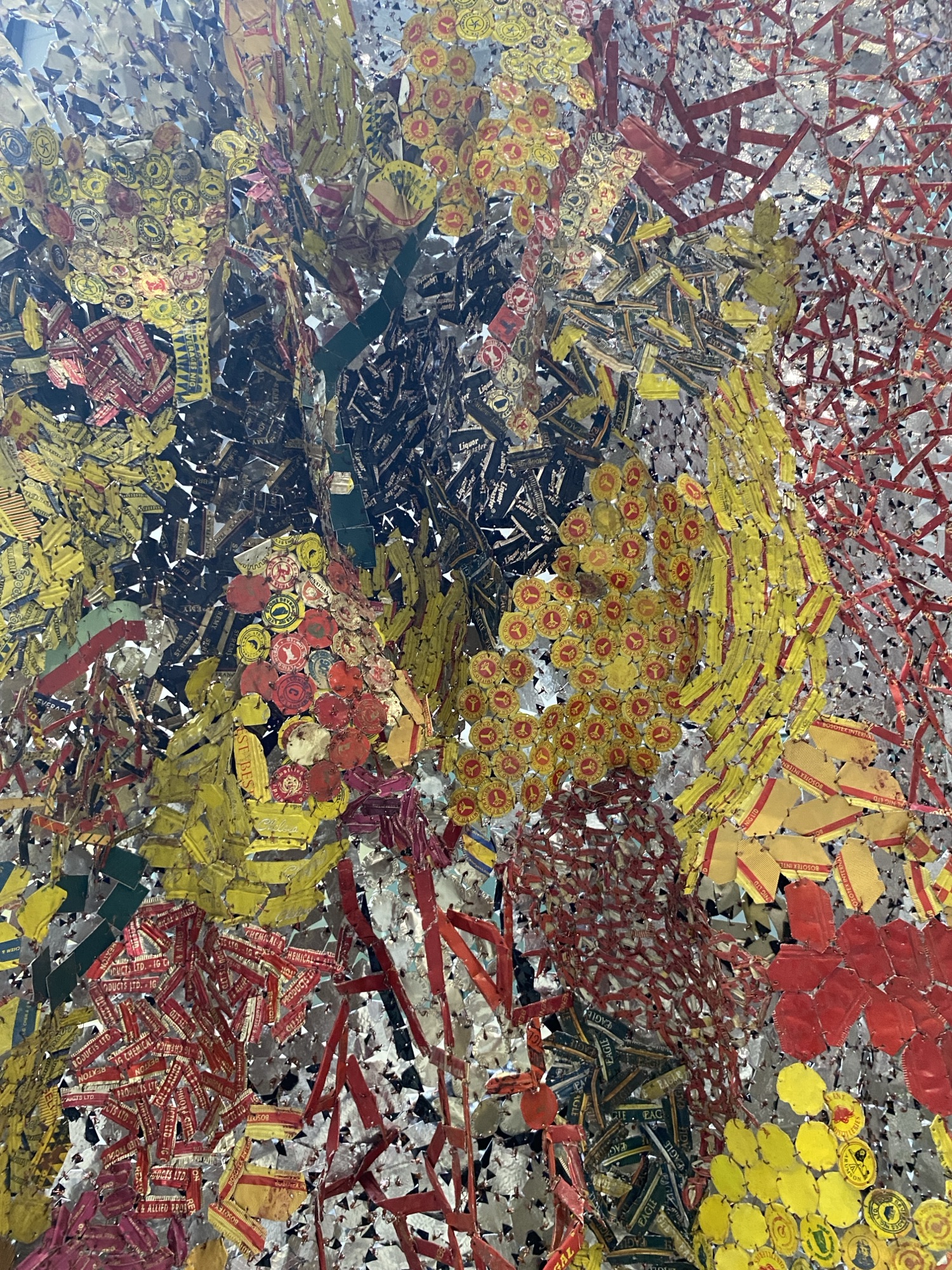
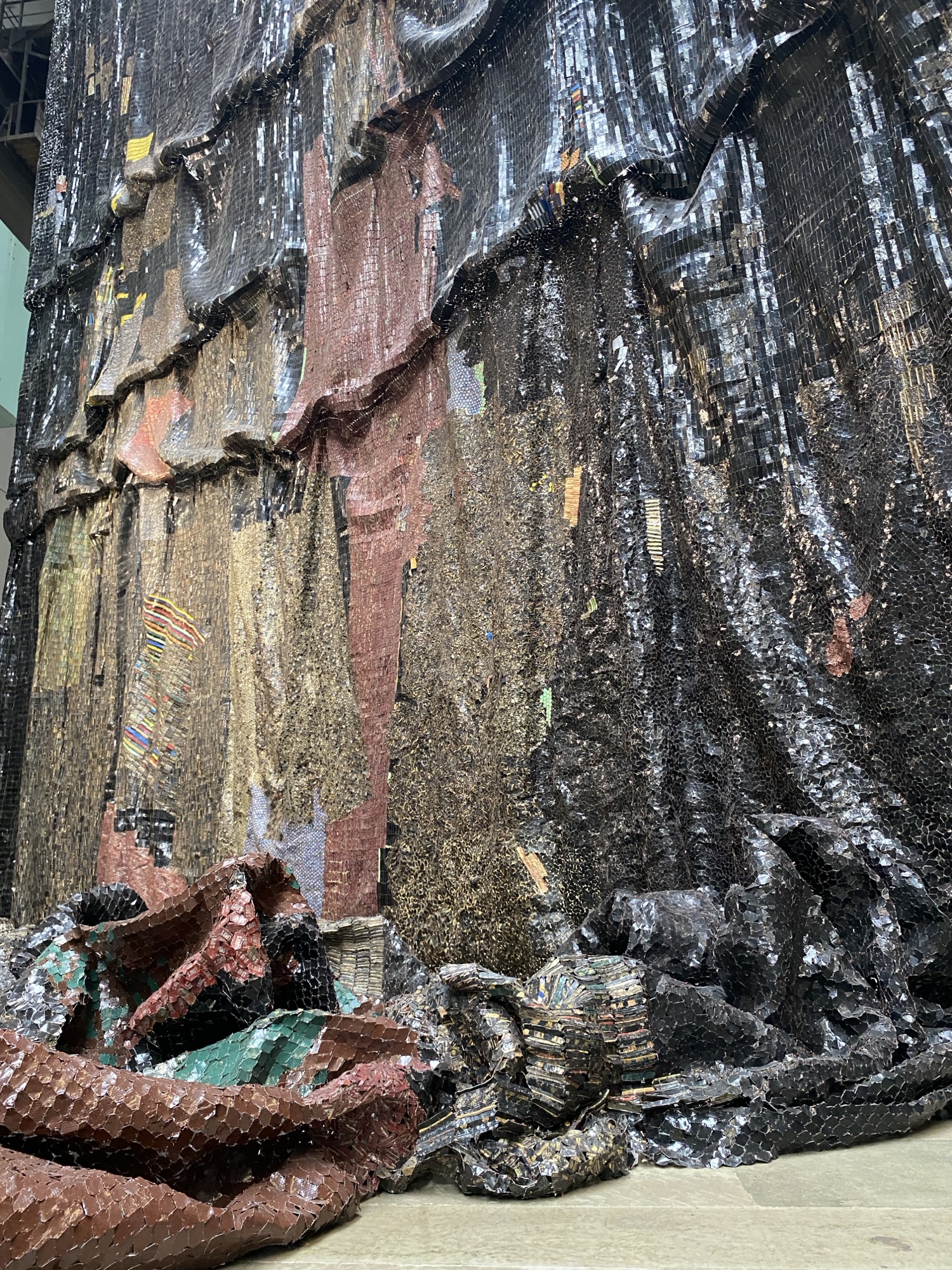
I have never seen a dragon in person, but I now have an idea of what it might be like. I had that very distinct sense as I walked under El Anatsui’s Behind the Red Moon installation at the Tate Modern on Tuesday. Thousands upon thousands of found metal pieces, stitched by hand with copper wire hung over my head as I passed under. Together the effect was one of a skin so giant, so monstrous, that it must have belonged to a mythological being. Each piece, like a dragon scale, with a reflective sparkle, responsive to light, and shivering in the air.
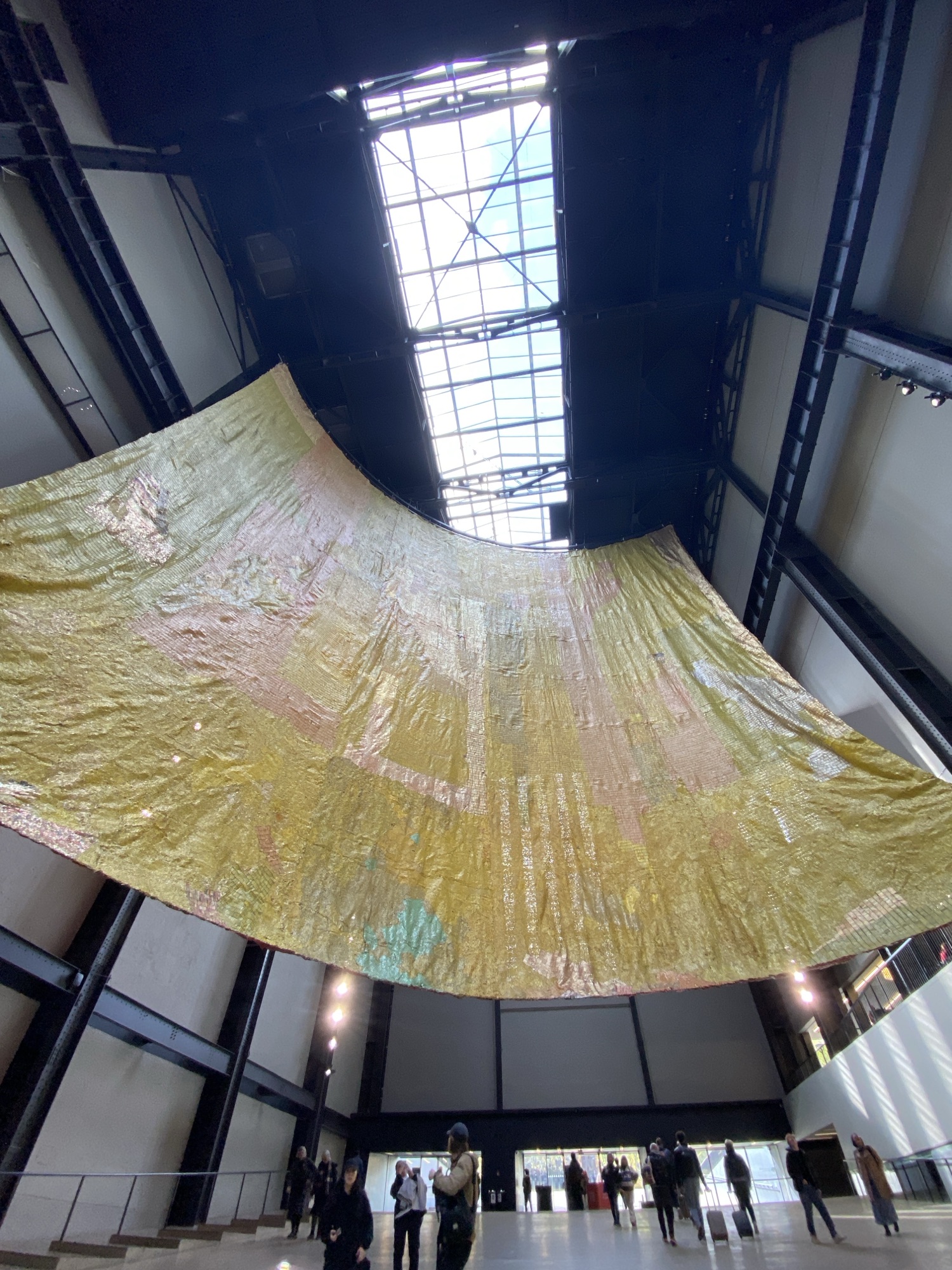
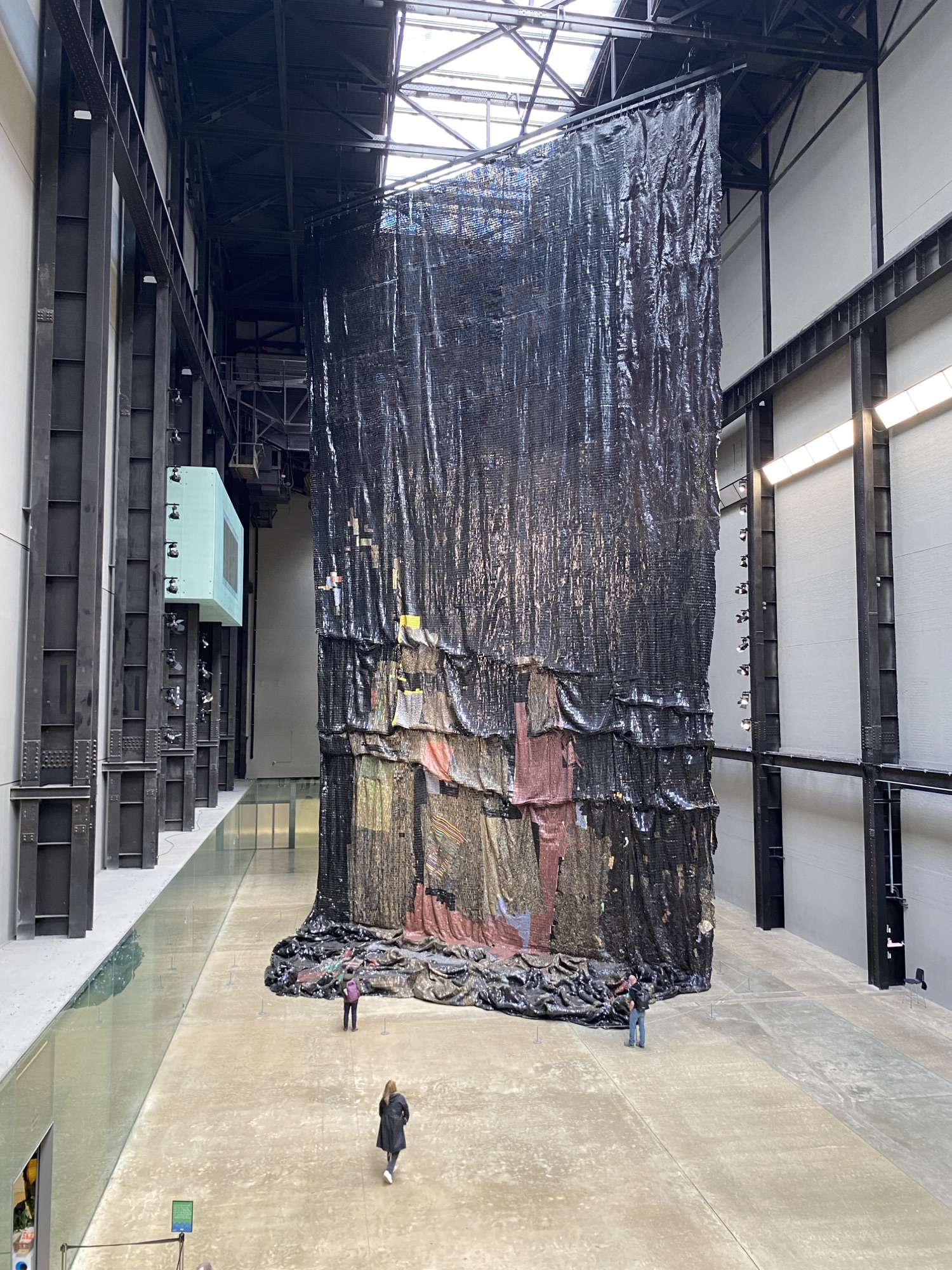
Behind the Red Moon is an installation “in three acts” by artist El Anatsui on view until Sunday, April 14th in the Turbine Hall of the Tate Modern. In a separate interview, the artist has talked about art as playing, as well as said the golden rule of art is that there are no rules—the worth of an artist is how they operate without rules. Both of these sensibilities are apparent in his installation. Walking in through the main entrance of the Tate, I was immediately caught up by the playful use of discarded and found metal—each piece handled, cut, punctured, stitched with copper and reassembled into larger panels, and finally installed as a gigantic whimsical whole in the industrial space. This vision of the tiny particles together with the impact of scale installed colorful suspended sail suspended invites story, mythology and imagination.
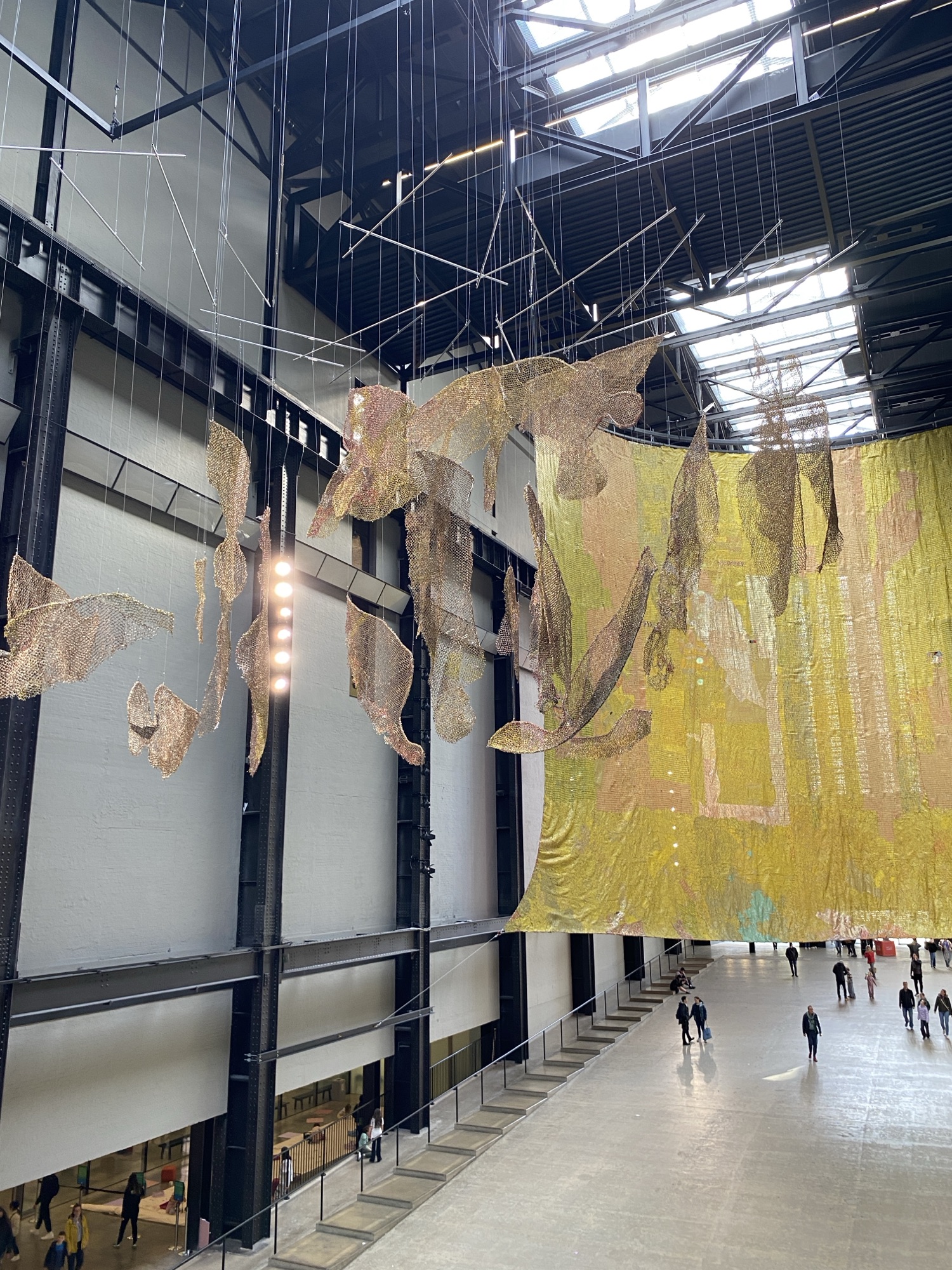
Act II of the installation is a cluster of suspended shapes. While they hint at recognizable forms, they are abstract and playful. Tiny, especially in contrast with the sail behind them, they move with the viewer and interact with each other to explore fragmentation and reunion. Viewed from a particular point on the 2nd story, they assemble into a complete spherical whole, expressing a core idea from the artist that “breaking is not a destruction but a necessary reforming.”
The final act, The Wall, hangs from the ceiling at the end of the turbine hall, a cloth of shards, cascading into waves of metal fabric. Like The Red Moon this work is composed of thousands of tiny metal pieces, stitched together with copper wire. It was this final act that struck me with awe–able to appreciate the full range of scale from the bottle cap logo to the colossal scale of the work in its entirety.
El Anatsui has spoken about his feeling that the earth is “losing her skin” through mining, as though the act of taking from the earth is to remove something protective and intrinsic. This material, mined, shaped, discarded, found, finally becomes reassembled through the imaginative play of an artist. Even if El Anatsui was not thinking of dragons in particular, it is a mythos I read into the work, a “poetic potential” offered by the material. Both serious and playful, Behind the Red Moon reads like a myth of a dragon. Maybe piece by piece, we have removed dragon scales from her body–and maybe, one day, she might want them back.
 Alexandra Ross Works