
–An Exhibit Response to Jonathan S. Green’s Needful Stones
I do not consider myself a very sensitive person. If sensitivity is on one end of a continuum and stoicism is on the other, I naturally tend towards stoicism, and selectively dabble in sensitivity. I know this because I grew up with a sensitive sister. Compared to her, I am on the far end of stoicism. She is the kind of sensitive who cried on her 8th birthday because she was feeling the weight of her mortality. I was not allowed to play certain songs because she found their beauty dysregulating. I learned the hard way that joking about eating bugs was not funny, and later on, well into adulthood, learned that she empathized with dented cans of beans in the grocery aisle because they were likely to be left behind, alone, while shoppers chose the “nice” ones to take home.
As I made my way through Jonathan S. Green’s exhibit, Needful Stones, I was reminded of this deep capacity for empathy. In this exhibit, currently on view at the Buhler Gallery in the St. Boniface Hospital in Winnipeg, Green offers viewers the opportunity to step over the threshold that divides the world into animate and inanimate and into a world of kinship with stones.

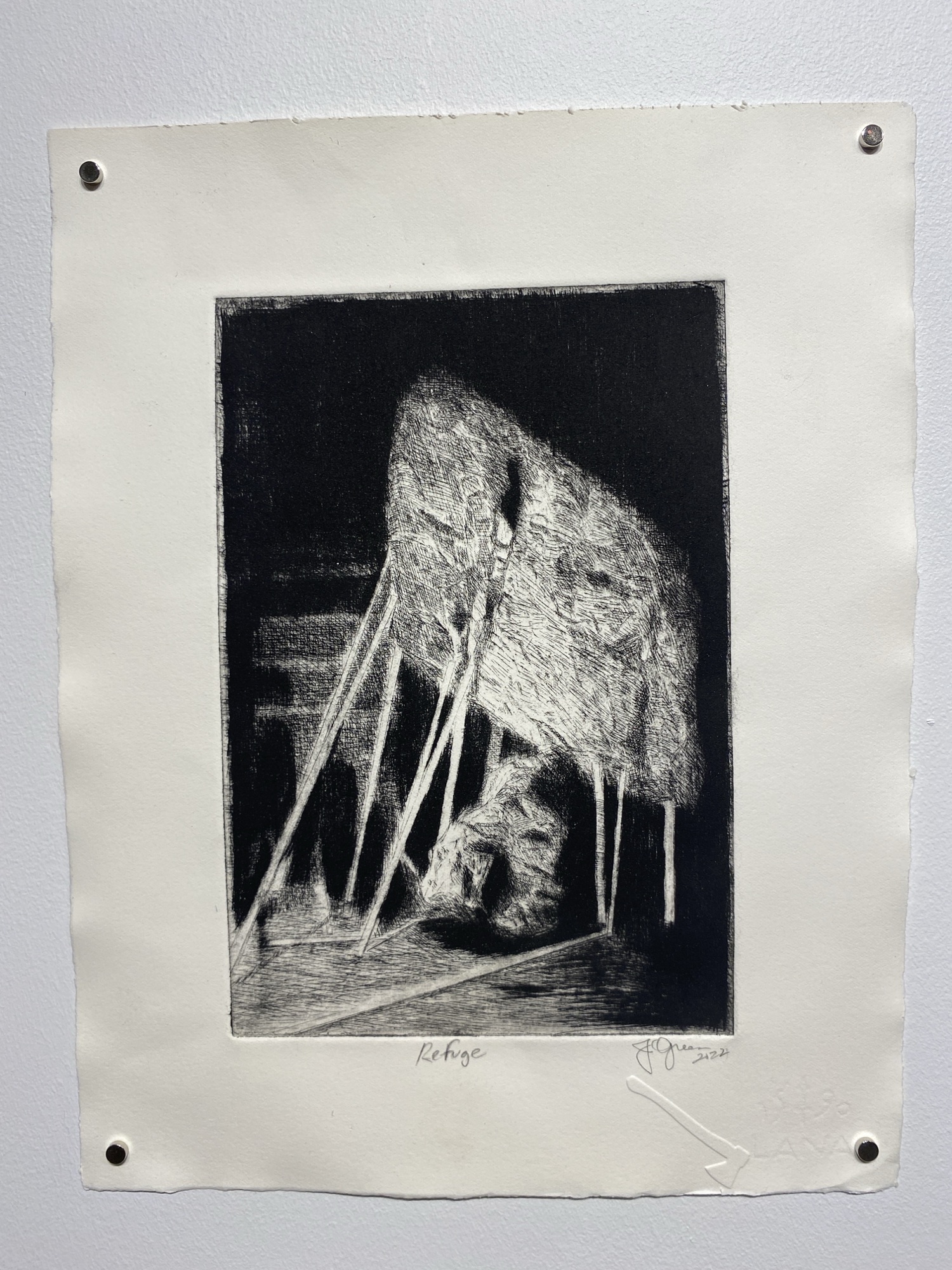


Most of the exhibit consists of prints, lithographs and intaglios, depicting stones, often in relationship with each other. That sentence fails to indicate just how moving many of the images are. As I made my way past the wall title, and took in “Geological Faults” I was immediately surprised at my own connection to seeing a small stone in relationship with a larger one. This was not the only work that I found emotionally compelling. Both “Refuge” and “Gros Morne ensemble” had a similar impact, inviting me to read my own relational experience into the bodies of seemingly inanimate mass. On the opposite side of the spectrum, I found myself taking offense at the viewer who would see two stones together and feel insecure enough to feel they were “conspiring” against them by huddling in a corner. I felt drawn to champion their right to assemble.
Throughout many of the images of stones, the artist has drawn thin support sticks, as if someone thought to reinforce them. It made me think of the vulnerability of being under a precariously balanced mass, like a rock formation. To contend with the mass of the object is to contend with feelings of being small and vulnerable–utterly helpless in the event of the stone shifting or falling. I identified with this imaginative person reinforcing the stone–this futile, yet soothing response to give some structure to the otherwise perfectly content mass. The structures become more about supporting the poor psyche undone by the mass, rather than what the stone actually needs, or perhaps wanted.
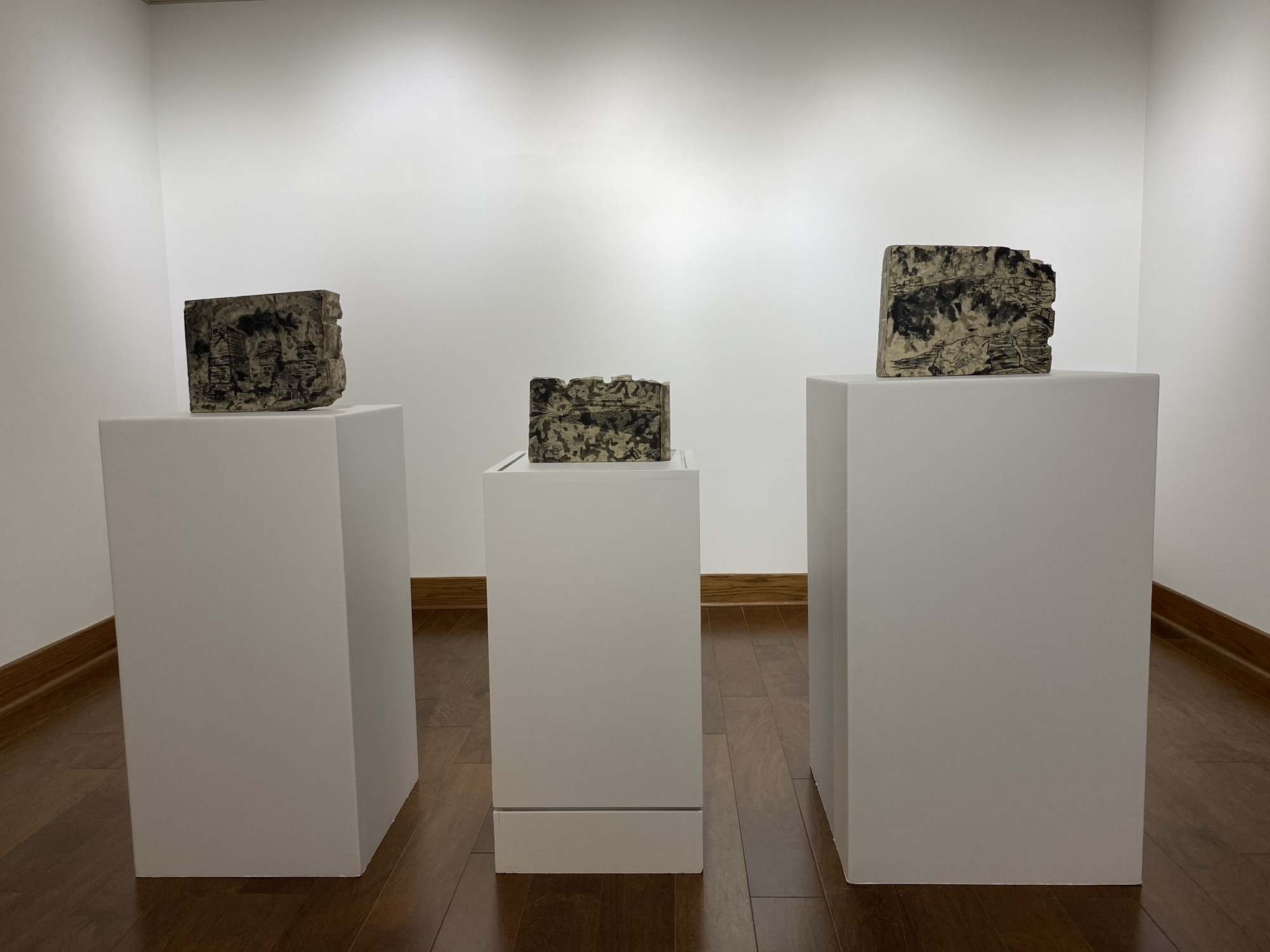
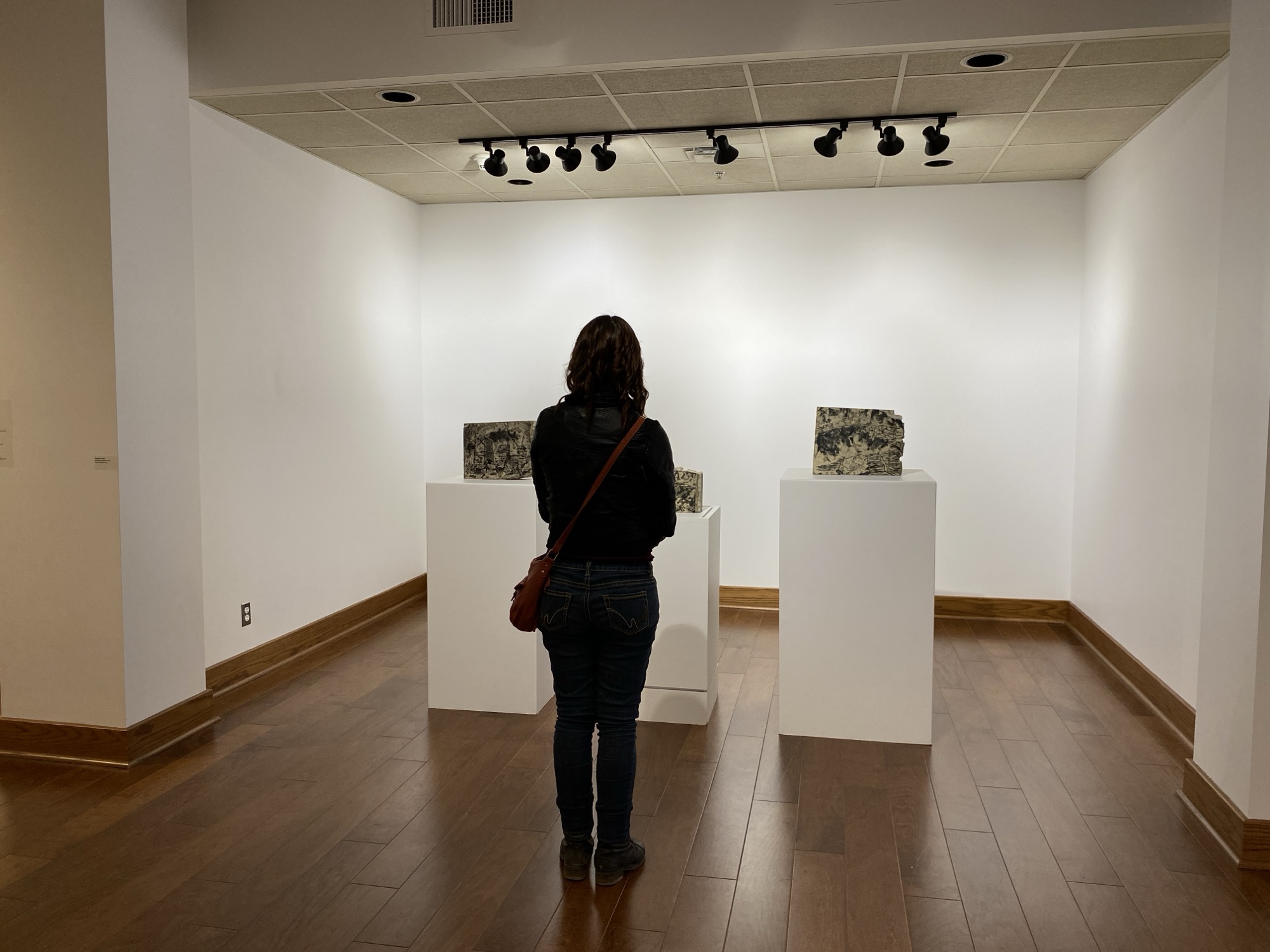
Along with the prints, at the center and back of the exhibit, there are three quarried stones installed on three separate plinths. They stand out in their materiality from the papers on the wall. These are the stones that Green took to the quarries, “for a visit” referenced in an hanna_g’s exhibition essay The combination of this idea, taking stones for a visit back to a community of stones, together with the series of images of stones in relationship with each other, that I found personally moving and deeply resonant.
Growing up my sister’s sensitivity was annoying. It got in the way of my will to move through life with boldness. But now, much later into my adult years, I find myself in awe of those who have capacity to find kinship with seemingly inanimate objects like dented cans and stones. At a time when the alarm bells of the climate crisis are constantly ringing, it is hard to find pathways through the bewildering array of do’s and don’ts. The urge to set up sticks against the mammoth weight of it all is a strong pull. Instead, here is a gesture into a totally different approach. Maybe the stones are needful. Maybe the mammoth mass is not against me, but inviting me into kinship. Maybe it does not need my sticks. Maybe it needs me to listen with empathy. Maybe it wants to go back to the quarry and visit friends and family.
Sometimes life does require stoicism. Sometimes life will throw curve balls that require shutting down sensitive capacities if we are to navigate without becoming dysregulated. However, increasingly I feel that empathy, not stoicism, is what will help us navigate though the massive collective curve balls we all face–and if we can reach out past our protective shells, past our need to reinforce our power with our futile sticks, perhaps our kinship with stones will help us through the mammoth task of navigating structural change.
Green’s exhibit is on view at the Buhler Gallery at St Boniface Hospital until April 28th. Also, he will be doing at artist talk next week, April 11th at 6:30pm.
 Alexandra Ross Works