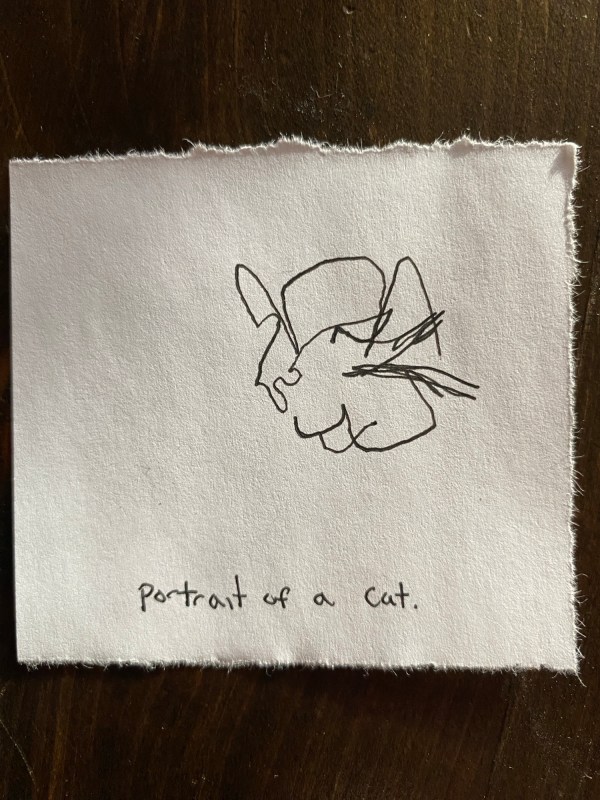
One of the most common responses that folks have when I tell them I am an artist, is to confess to me that they cannot draw. It is like they need me to know they are not one of my kind–my kind being those who are able to represent the material world with a pen or pencil.
My instinctual response is “that’s ok, neither can I.”
I don’t usually say this outloud because I don’t actually think that’s the point. When I hear people say they cannot draw, what I hear them telling me is that they have forgotten how to see. We all do in order to survive life. I learned about this in my first year drawing class. If you were to look back at the pictures you created as a child you might notice that at some point you stalled out. In that way, you might have been better at drawing when you were five then when you were twenty five.
This is because your brain gets more efficient in processing information as you age. A young brain is processing everything for the first time, and spends time actually looking at the world around them. If you want proof of this, hang out with kids ages 3-7 to remember just how much you don’t notice anymore. Kids have ways of observing the world and asking questions from their observations, like whether penguins have knees? (The answer is yes, but it did require some googling.) At some point an “efficient” brain will stop looking and start making information shortcuts, like icons.
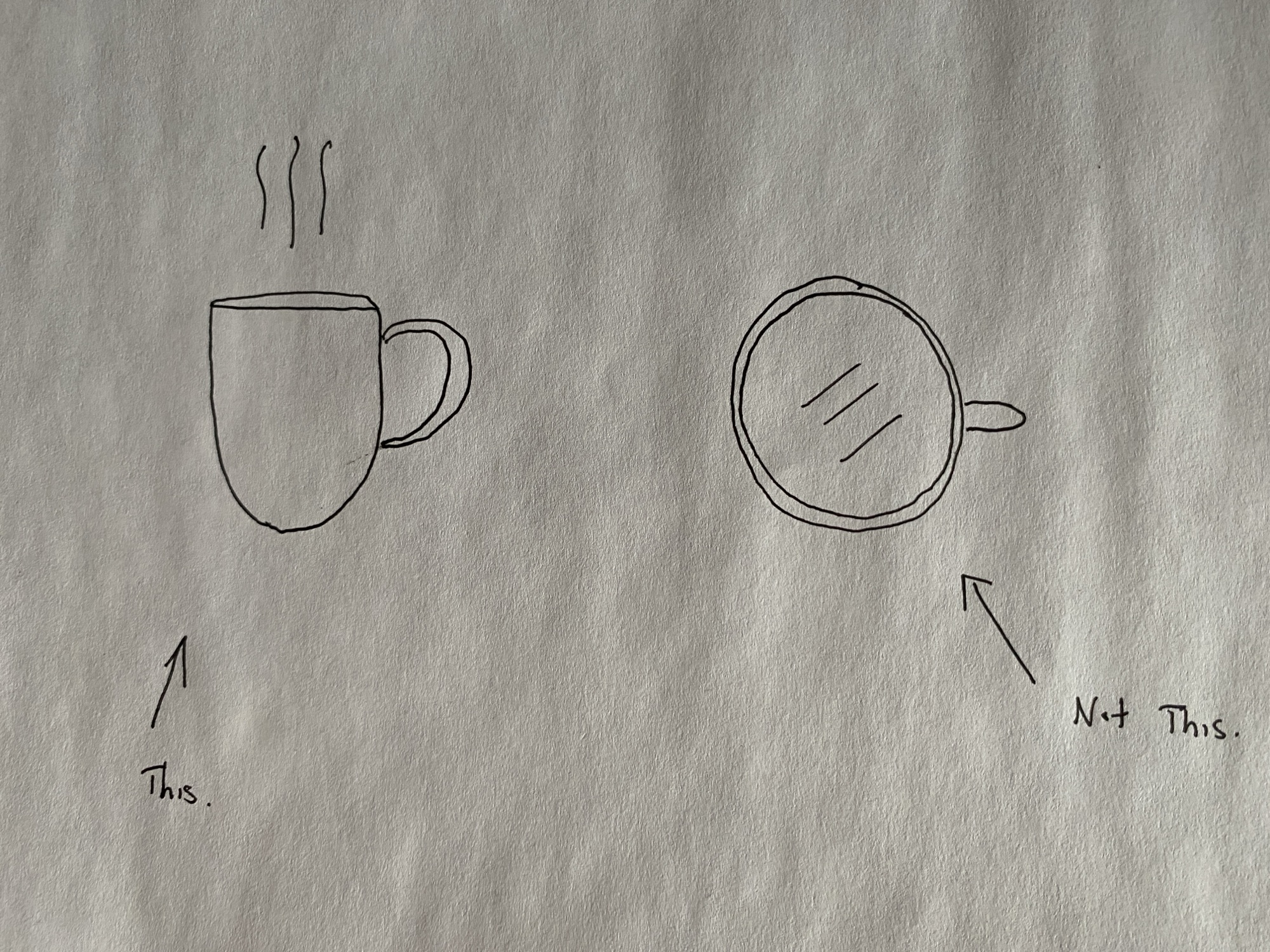
For example, if I told you to draw a mug of coffee, you would probably draw a profile of a mug, handle to one side, rather than the top of the mug. You likely wouldn’t even need to look at a mug to draw it, because the mug is an icon in your brain. Conversely, if I sketched out a coffee from the top and asked you what you thought about my drawing of a mug, you might question my identity as an artist.
Creating shortcuts, or icons, is a brilliant way to move through the world when it comes to processing information quickly. There just isn’t enough time in the day to carefully examine everything. However, what you gain in efficient information processing, you lose in actually looking at the world around you. You stop seeing; you stop really noticing particular aspects of a moment. Like the translucence of a china teacup, or the indent your thumb makes when it rests on your leg, or how there are as many shadows as there are light sources.
The good news is that it is possible to learn how to see again. It is not actually that hard to train yourself to see. Well, it is about as hard as stretching your hamstrings every morning–which is nearly impossible–however, there is an exercise that helps artists learn to use our eyes and not our brains when drawing.
Ironically, the exercise to help you see is called a “blind contour.” It is very simple. Like touching your toes.
Take a pen and a paper and choose a subject. Anything in front of you–your phone, a mug, your pet–anything material. Without looking at the paper and without lifting your pen, let the pen move with your eyes around the object. You will want to lift your pen, and will have an instinct to look at your work.
Do not.
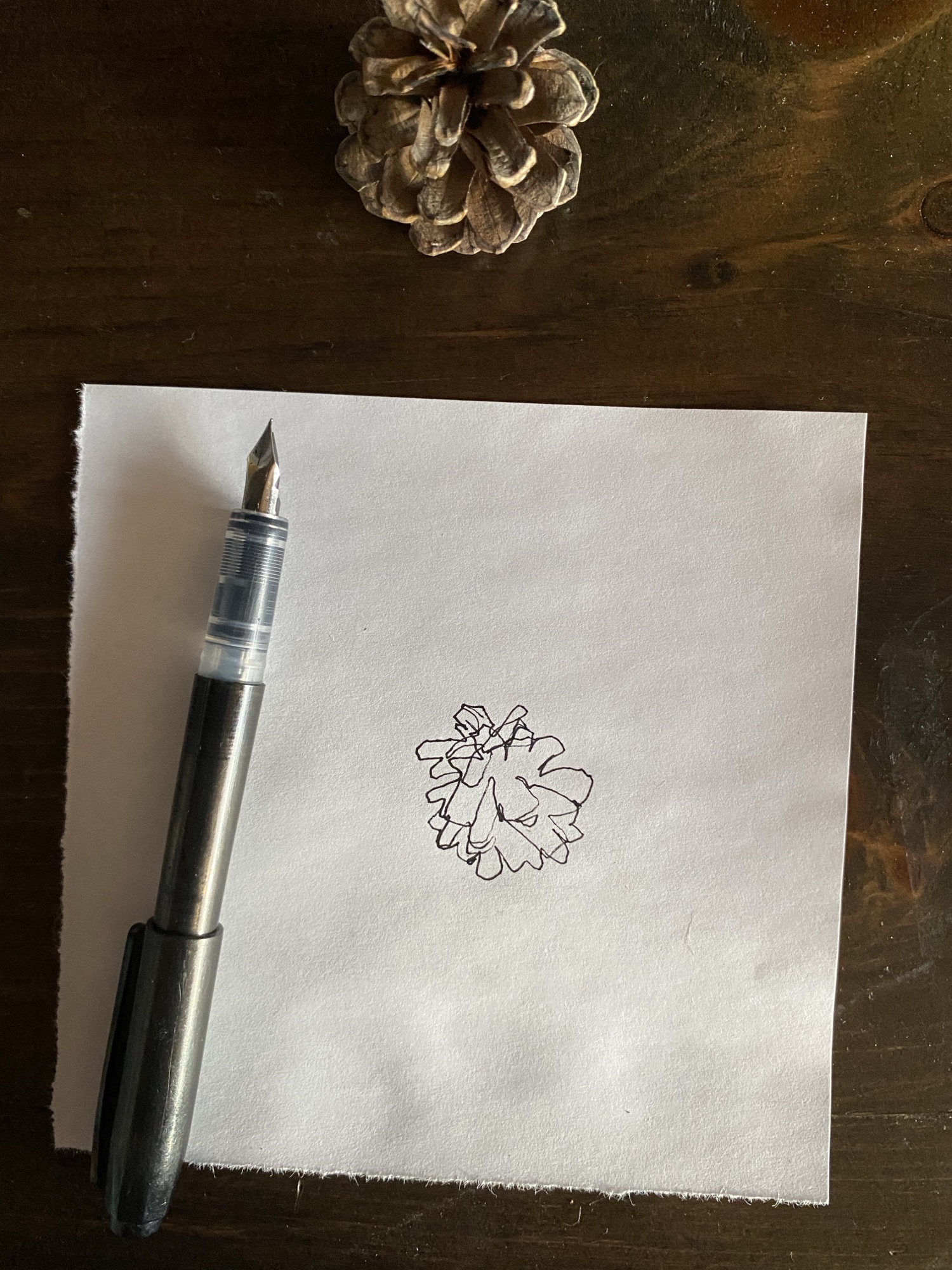
This is not about drawing a “nice” picture. It is about short circuiting your cerebral shortcut. Initially I had to move the paper to the side so I wasn’t tempted to make it “nice.” Trace as many details as you like. Maybe you just do a basic shape, or maybe you add in the reflection of light, the textures, and the shadows. It’s up to you.
When you are done, lift your pen and look at your work. You should see a scrambly mess of pen on paper with some absurd moments that feel embarrassing and make you think, “I AM BETTER THAN THIS.” That is what you want. If it looks too good you have either cheated or have been doing this everyday for three years–or you’re a genius. Cheater, artist, or genius, ideally what has happened is that you have spent much more time actually looking at something than you normally would.
So now you know.
If you are one of those people who meet artists and have an urge to confess to them, “I can’t draw” I have let you in on our secret. None of us can. For most of us artists we have just learned how to slog it out and practice seeing again. But even if that doesn’t make for good drawings, at least it means we are better at keeping up with five-year-olds. There’s always pottery.
 Alexandra Ross Works
Seeing is essential.
There is another factor that can be very frustrating though – ability to visualize. I suffer from significant aphantasia – “an inability to create vivid mental imagery”. I’ve found this to be a huge obstacle as a creative artist.
It’s an interesting experience – usually it’s described as above, an inability to visualize. My own experience is slightly different – when I imagine something I can see it as a rather vivid flash that fades away instantaneously, leaving insufficient time to truly SEE the image and draw it.