
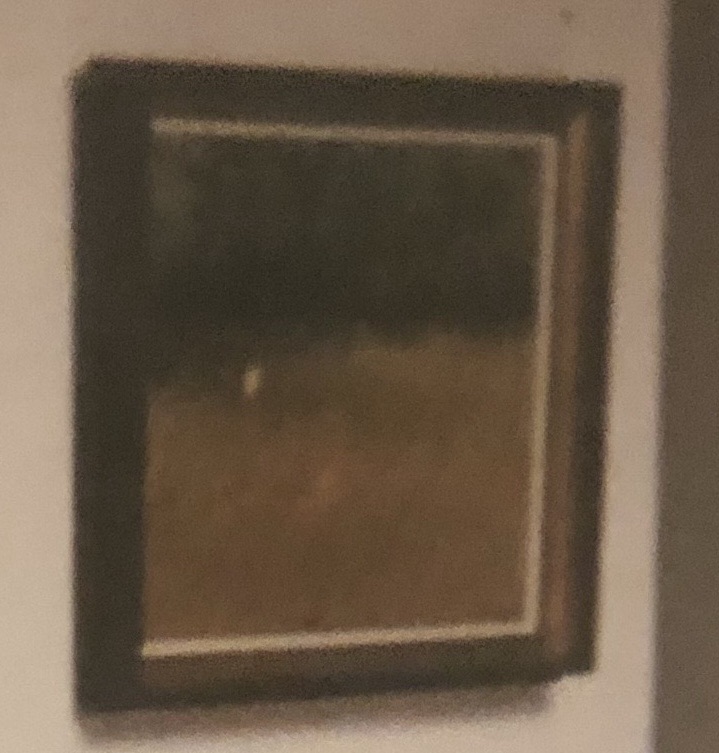
Would you believe me if I told you works of art are magical? I am convinced they are–that is to say, works of art are not static, but they are unpredictably dynamic and have capacity to shift and change with you. Even works that you did not like or choose, can grow on you. You can look at a work for years before you like it. Alternatively, you can “grow out of” works that you once loved and valued, only to cycle back into appreciation after another decade has passed.
I did not like or choose my first work of art. When I was born I was gifted a painting by my godmother, Marjorie Willis, from her personal collection. She was an artist and designer among many other things, and gifted art to my sisters and I when we were born. Growing up, I thought they got the better ones. My older sister received a framed Guna Mola. It depicted the crucifixion scene with geometric shapes and brightly coloured fabrics. My younger sister received the largest work in the most elaborate frame. She was given a work by Marjorie herself. It was a watercolour of her home–a large white southern house with a wrap-around porch. Both of them had more detail, and were far more relatable to my young mind.
The work I received was an oil painting of a girl in a field. Behind her there was a dark green forest and laid out in front of her was a wild prairie field. The work was gestural–the forest in the background did not depict actual trees so much as wild circular motions of hunter, forest, and olive greens. A few lines thrown into the mix indicated trunks, drowning in the foliage. The field might have been created in layers, with shades of umber, bronze, and orange, then finished possibly with a dry brush delineating individual stalks of grass. The artist then threw speckles of paint which gave the work an impression of a blustery day blowing up grass seeds in the wind. For such a still picture there was a great amount of movement. At the top of the field, and to the left, standing between forest and field, there was a young girl, her arms by her side. When I say there was “a young girl” I mean there was a smudge of paint indicating a frock, and another smudge indicating a face and hair. She was the stillest part of the painting, looking over the field with just the slightest indication of an expression.
Unlike objects made for consumer trends, art has the capacity to age with you. While initially I did not care much for the painting, my relationship with it changed as I grew up. I was a wild child and did not identify strongly with the figure in the field. Then one day, while taking the picture down during a room change, I flipped it over to find an inscription on the back. It was written to me, and contained a verse about finding the divine in stillness. I flipped the painting around again. The work had opened up to me–magic.
I saw something I had not appreciated before: this was not a picture of a girl in a field–this was a picture of a girl having an inner experience in an exterior world. Suddenly I understood that this was not just about what I could see in the oil, but magically I could also feel something within in. In that transformative moment, I could relate to the girl in the field–I too had inner experiences in the wild. To top it off, she had mouse-brown hair with bangs, and so did I! Maybe that girl in the field was me? I returned the work to its new spot, now newly transformed in my mind. As time went on my love of the work deepened and I returned to it to think about my own experience of finding stillness amongst the wild movements around me.
Sadly the work was lost when I moved internationally as a teenager. I had taken it out of its frame so I could bring it with me. I rolled it up and put it between some books and blankets in a trunk that never reached me in my new home.
The work might be physically lost, but it lives in my memory, and I still return to it. I still identify with the girl in a field–caught in the liminal, solitary, but not alone, at peace in the wildness of the life around me. My understanding and appreciation for the work has changed and shifted over time, just as I have changed and shifted. In my opinion, that is one of the most mysterious and beautiful things about works of art.
 Alexandra Ross Works